A Systematic Review on Prospects and Barriers of Silk in Bangladesh
Kaniz Fatima Jui *
Program in Agricultural Economics, Bangabandhu Sheikh Mujibur Rahman Agricultural University, Bangladesh.
Saifur Rahman
Department of Agricultural Extension Education, Bangladesh Agricultural University, Mymensingh-2202, Bangladesh.
Md. Akter Faruk Fuad
Program in Environmental Sciences, University of Tsukuba, Ibaraki 305-8577, Japan.
Umme Munmun Ashrafi Flora
Program in Business Administration, ASA University, Bangladesh.
Md. Hassan Shafiul Alam Shanto
Exim Bank, Bangladesh Agricultural University, Bangladesh.
Md. Hasan Sofiur Rahman
Bangladesh Institute of Nuclear Agriculture, Bangladesh.
Homaira Siddika
Program in Agroforestry, Bangladesh Agricultural University, Mymensingh-2202, Bangladesh.
*Author to whom correspondence should be addressed.
Abstract
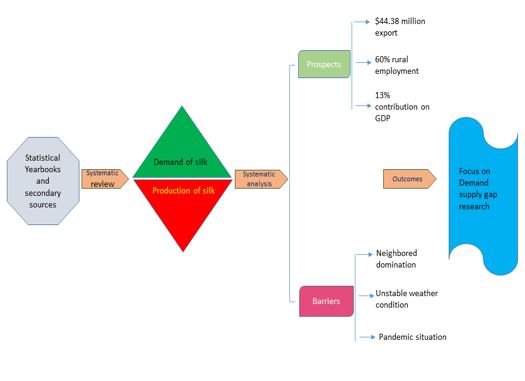
Sericulture is an ancient agricultural practice and silk production has economic as well as historical importance in Bangladesh. The study has reviewed the prospects and barriers of silk compiling the production to industry level. In the last five years, silk production has decreased from 46 to 41 metric tons. As the total demand for silk in Bangladesh is 300 metric tons, it created import pressure, accounting for an average of 393.73 metric tons. Bangladesh produced 1099 kg silk yarn which contributed to the 4.43million USD export return and made the emergence of light more than in previous years. This paper shows that 75% of the total rural population lived in rural areas, and more than 60% of the total population directly or indirectly depended on agricultural activities where majority of employees were women, accounting for 60%. Bangladesh has achieved the honor of becoming the second largest exporter of Readymade Garments (RMG) which employed 4.4 million people and exported 81.16 million dollars, contributing about 18% of the total GDP. But the condition stagnated regarding the proper timing of raw materials procurement, temperature fluctuation, the Covid-19 outbreak, and others. Bangladesh Sericulture Development Board, Bangladesh Sericulture Research and Training Institute, and other non-government organizations support are required for its further growth.
GRAPHICAL ABSTRACT
Keywords: Sericulture, mulberry, Bombyx mori, readymade garments, GDP, silk, employment, COVID-19